Network Enhancers - "Delivering Beyond Boundaries" Headline Animator

Showing posts with label Project Stratus. Show all posts

Sunday, March 6, 2011

The Juniper QFabric FAQ

by Tim Greene
Juniper Networks has introduced its new data center architecture called QFabric, which promises improved performance and economy. Here are some questions and answers about the new technology.

What is QFabric?

It is Juniper’s new data center architecture that creates a single logical switch that connects the entire data center rather than tiers of multiple access aggregation and core switches.

Why is that an advantage?

It improves performance by reducing latency, which is accomplished by getting rid of layers of switches and cutting the number of devices needed, which also reduces the demand for space and power as well as management and maintenance.

What devices make up QFabric?

The architecture deconstructs a traditional switch into three component parts, an ingress-egress platform called a node, an interconnect platform corresponding to a switch backplane and a management platform that gives a single view of the fabric.

How does this flatten the architecture?

The node has switching and routing intelligence about all relevant paths through the fabric and makes Layer 2 and 3 forwarding decisions. Since nodes are logically connected peers, there is no need for aggregating ports with banks of access switches that feed aggregation switches that feed core switches. Packets are switched directly to the appropriate egress port.

Why is this fabric faster?

Packets are processed once and forwarded to the appropriate port without having to be reprocessed at every layer of a hierarchical architecture. Packets get through the infrastructure in a single hop. Juniper says delay is  5 microsec  maximum across a data center at maximum cable length. Shorter lengths yield 3.71 microsec delay, which Juniper says is less than in a chassis-based Ethernet switch.

How does QFabric deal with congestion?

With its knowledge of other nodes, each node can sense congestion as it develops and adjust its forwarding rate accordingly. Juniper won’t say exactly how this mechanism works because it is trying to patent it, but it promises that the whole fabric is lossless even under congestion.

What is the practical result of this congestion control?

By dealing with congestion dynamically and quickly, QFabric gets rid of the need to over design the network to accommodate it. That boosts network utilization to near 100%, Juniper says.

What are some numbers on how well this fabric performs?

The average data center – defined by IDC as having 3,000 servers – using QFabric rather than a traditional three-tiered architecture is six times faster, requires 22%fewer devices overall and incurs half the operating expenses.

Does this have implications for cloud architecture?

Yes, but not immediately. Juniper says that it will announce later a means to incorporate WAN connections into QFabric, making it possible to link dispersed data centers to support cloud services.

Saturday, March 5, 2011

It’s Here: Revealing the QFabric™ Architectu​re


by Juniper Employee


QFabric-Logo.jpg


At last the big day is here!  Juniper has been talking about the power of a data center fabric for two years, since we first publicly disclosed the existence of Project Stratus.  We’ve discussed why we were building a fabric and what it would mean to our customers.  But we have intentionally been silent on the specifics of the architecture and the underlying technological magic.

That changes today.  In simultaneous locations around the world, we are sharing the secrets of QFabric, the fruit of the Stratus project, via webcast; and introducing the first component of the fabric, the QFX3500 Switch.

A few hundred years ago, a Franciscan friar named William of Ockham professed a concept that today is known as Occam's Razor.  He stated that when confronted with multiple alternatives, the simplest path is usually the correct one.  That is the defining concept behind QFabric.  Pradeep Sindhu, our founder and spiritual leader, looked at the data center network and saw a simpler, more correct path to solve this most difficult of network problems.  We believe the path he chose can eventually transform every data center in the world.

I have written extensively on why flat fabrics are the only natural solution for interconnecting the infrastructure of the modern data center.  Other vendors are attempting to build data center fabrics using their existing Ethernet switching components, but instead of focusing on the network, they focused on their switches.  It’s like being a brick manufacturer and deciding to build a high-rise building in California entirely out of bricks.  It is possible; it’s just a really bad idea.

The Simplest Path

Pradeep took a clean sheet approach, the simplest path.  That it would be a flat fabric was a given.  That it would adhere to network standards and not change the way applications, servers, storage, and other infrastructure components connect to the network was also a given.  Where the brilliance lies is in the inherent simplification of the network.  Push the intelligence to the edge of the fabric.  Minimize the amount of processing and hardware required to transport data across the fabric while maintaining any-to-any connectivity.  Enable the fabric to scale from tens of ports to thousands or even tens of thousands of ports while maintaining the simplest and most proven operational model—that of a single switch.

The challenge with describing new products that fundamentally transform the world around them is placing them in the right context to discuss and measure the revolution.  Simply put, the QFabric delivers the performance and operational simplicity of a single switch while delivering the scale and resilience of a network.  We believe there is nothing else like it in the world.

To achieve this, Pradeep and the architects rethought almost every aspect of a switch.  The resulting innovation is captured in more than 125 new patent applications filed as part of the project.

Design Principles of QFabric

QFabric is built on three design principles:

  1. Build a data plane that ensures any-to-any connectivity across the entire data center while minimizing network processing.  This requires pushing the intelligence necessary to process incoming packets and handle  the complexity of the real world to the edge of the fabric, The interior of the fabric focuses on merely “transporting” the bits—a simpler, less costly activity.  This is the only way to enable the fabric to economically scale across the entire data center while delivering the blazing performance and low jitter required by modern applications.
  2. Build a control plane that distributes and federates the real-time control of the fabric, placing the intelligence that controls the fabric into every edge node to ensure low latencies and inherent resilience.  Then provide an out-of-band control plane to ensure the federation of this intelligence, enabling the fabric to behave as a single switch without resorting to flooding, without worrying about or managing loops, and without needing to run spanning tree or a Trill.
  3. Build a management plane on top of the control plane that automates and abstracts the operation of the fabric while presenting the simplest and best understood operational model to the administrator—that of a single switch.  This is not a network management application that enables a single pane of glass to manage multiple autonomous switches.  QFabric is in fact a single switch.

The result is a fabric that:

  • Is blazingly fast.  In an internal test we found that QFabric can deliver sub five-microsecond latency across an entire data center.  And that is assuming maximum length interconnect cables which add more than one microsecond of that latency due to the speed of light.  With shorter cables we have measured latencies as low as 3.7 microseconds.  That QFabric is the world’s fastest fabric (over 500 ports) is a given.  What may be a surprise is that QFabric is faster than any chassis-based Ethernet switch ever built. And the fabric is consistently fast, delivering extremely low jitter under load.

    • Scales in a linear fashion from tens to more than 6,000 10GbE ports. In the future, we also plan to deliver mega-fabrics that will scale to tens of thousands of ports and micro-fabrics that scale under 1000 ports.  It’s a fabric for data centers of all sizes.

    • Delivers the ultimate in operational simplicity.  Because QFabric behaves as a single switch, it is possible to manage the entire fabric with a single network operator. 

    • Delivers a quantum change in the total cost of ownership.  This is not the normal puffery of marketing; QFabric is more efficient because of its design.  Reducing the processing elements required to build the fabric not only makes it fast but reduces manufacturing costs.  Fewer hardware elements also require less power, cooling, and floor space.  Fewer hardware elements also mean greater reliability and lower support costs.  And finally, the inherent simplicity of the fabric will reduce management costs.  Hard to beat that.

    Introducing the QFX3500

    Today we also introduced the QFX3500, a remarkable new product that not only serves as the edge node of the QFabric, but can also function as a standalone, 48-port 10GbE top-of-rack data center access switch.  It too is blazingly fast, delivering under 780 nanoseconds of latency.  We recently teamed with IBM to run the STAC benchmark which measures application throughput and latency on a financial services workload; the result showed the fastest Ethernet performance ever recorded and only one microsecond slower than Infiniband. With the QFX3500, you can start by implementing a more traditional network topology, have it interoperate with any existing vendor’s infrastructure and upgrade to QFabric when you are ready.

    What does this mean to the business?

    While great technology is fascinating, at least to me, what does QFabric mean to the business?  It's quite simple:  QFabric will unleash the true power of the data center.  A fast fabric will enable every application to perform better, delivering a better user experience.  A flat, scalable, transparent fabric delivers a more elastic data center and ultimately greater business agility.  And the inherent simplicity of QFabric enables the entire data center to operate more efficiently and reliably.  Better experience and better economics.  What more could you ask for?

    Thursday, March 3, 2011

    Juniper attacks core networking market with Stratus QFabric


    Networking company Juniper has released a new technology weapon — its Stratus QFabric switches and architecture — to conquer the core network switching space.

    Released three days ago in late February 2011 in a worldwide launch, Juniper’s QFabric architecture is claimed by them to be a technologically superior way to implement network architectures, yielding both higher performance and significantly lower costs.

    Lam Chee Kiong, enterprise solutions manager for Asia Pacific at Juniper Networks explained that an ideal network architecture has a few key attributes like low latency, high reliability and scalability. These are typically implemented in a three tier networking framework, with core switches being surrounded by access switches and edge routers.

    Juniper’s QFabric architecture aims to do away with this.


    In the most extreme scenario he presented, a network architecture with 6000 server ports, he compared a Juniper QFabric architecture with a traditional Cisco architecture.

    Juniper claims that with their architecture they can shrink hundreds of devices into a far smaller footprint — four chasis racks — consuming 90 percent less floor space and using 66 per cent less power.

    On top of that, in their scenario, they project that their network speeds will be up to fifteen times faster and require far less management devices — one as compared to hundreds.

    This is done by consolidating all the QFabric switches and allowing them to be plugged in directly to the QFabric interconnects. An analogy would be to think of the QFabric architecture as a series of blade servers, but instead of computing or storage, it is for networking solutions.

    Attacking Cisco in the data centre space

    With the worldwide network switching market’s year-on-year growth at 28.1 per cent for 2010, and a total valuation at US$21.1 billion according to research firm IDC, the future prospects look bright for Juniper.
    Indeed, Juniper’s last quarterly earnings beat analysts’ expectations and showed a 26.4 per cent year-on-year increase in revenue. With it’s Stratus QFabric launch, Juniper is poised to do potentially even better, and will threaten longtime rival Cisco’s share in the core network switching space.

    Juniper believes the QFabric solution will play well in the data center space as cloud computing and virtualization are two forces driving adoption. Both floor space and power consumption are big issues here, as well as the latency speed issues that the QFabric architecture solves.

    Said Chee Kiong, who estimates that data centres comprise 20 percent of the core network switching market: “The battleground is pitched at the data centre, because if it’s good enough here [to meet the stringent requirements], it’s good enough for other deployments.”

    In Asia Pacific, Chee Kiong is targeting two industries in particular: financial institutions and government. Banks require extremely low latency and robust solutions, and governments tend to house huge complex solutions which the QFabric can help more easily manage.

    The QFabric QFX3500 switch ships this quarter and is undergoing customer trials, and the full QFabric architecture — like the interconnects and control plane — will be available in Q3 2011.

    Juniper took hundreds of million of dollars and a million hours of R&D to develop the QFabric architecture, which started three years back in 2009 under project Stratus.

    Wednesday, March 2, 2011

    QFabric Network Pitches Juniper Against Cisco

    Juniper’s QFabric networking architecture collapses the traditional three-layer data centre infrastructure

    Juniper Networks is rolling out a new networking platform executives say will simplify the data centre infrastructure, driving up throughput, scalability and efficiency while reducing latency, operating costs and the number of devices required for a networking architecture. During a Webcast event from San Francisco, Juniper executives unveiled their QFabric architecture, an $100 million initiative formerly called “Project Stratus” that was launched after three years of development.

    The goal of the project is to collapse the data centre networking infrastructure from the traditional two or three layers down to one, a move that will enable enterprises and mid-size businesses handle the demands created by the onset of cloud computing and the growth of the mobile Internet.

    “As these trends accelerate, its creates exponential demand, and it’s that exponential demand that requires a new approach,” Juniper CEO Kevin Johnson said during the event.

    Challenging Cisco’s Data Centre Domination


    QFabric also gives Juniper a higher profile in the highly competitive data centre networking space, a market still dominated by Cisco Systems, but with a cadre of rivals trying to grab a larger share. Juniper still needs to continue to build on its initiative, but the QFabric push is a strong step, according to Forrester Research analyst Andre Kindness.

    “Even though Juniper still needs to deliver on parts 2 and 3, this product launch moves them up and puts Juniper Networks back in the Data Centre Derby with Arista, Avaya, Brocade, and Cisco,” Kindness said in a February 23 blog post. “Juniper’s vision overlaps layer 3 and 2, which keeps packets from running across fabric for something that can be done locally thereby eliminating waste. The design allows partitioning of network by workgroup, too. QFabric’s strongest differentiation is the single management plane that makes all the components behave as one switch without introducing a single failure point. Juniper’s QFabric drives simplicity into the data centre, a value long overdue.”

    The QFabric architecture essentially enables network administrators to manage the networking infrastructure as a single switch, with a single view of the fabric. Three components make up the low-latency, high-performance fabric, including the QF/Node, which Juniper executives said is the distributed decision engine. In addition, the QF/Interconnect is a high-speed transport device, while the QF/Director gives network administrators a single, common window through which they can control all devices as a single one.
    “It doesn’t just behave as a single switch, it is a single switch,” David Yen, executive vice president and general manager of Juniper’s switching business, said.

    Juniper unveiled the QFX3500 node is the first product in the QFabric product portfolio, and will be available later this quarter. Initially, it will work as a traditional 10 Gigabit Ethernet, though it will become more of a node in the QFabric architecture later in the year. The QF/Interconnect and QF/Director will be available for order in the third quarter.

    Johnson and other Juniper executives said QFabric will offer a host of benefits for businesses. It will be up to 10 times faster than legacy networks, use 77 percent less power, require 27 percent fewer networking devices, and occupy 90 percent less data centre floor space.

    “These are significant numbers that don’t come about every day,” Pradeep Sindhu, founder and CTO of Juniper, said during the event.

    SIndhu noted that because Juniper’s products support Ethernet and Fibre Channel, businesses will be able to gradually adopt the QFabric architecture, replacing competing products with Juniper offerings when needed. He also said that while QFabric is aimed at the internal data centre, Juniper later this year will offer technology that will enable a network architecture that can be used over the WAN to connect multiple data centres.

    Juniper’s rollout comes at a time of transition for Cisco. For the past two years, Cisco aggressively has been expanding its reach beyond its networking base, growing into such areas as servers – with its UCS (Unified Computing System) – collaboration technologies and smart grid solutions. Some analysts have argued that doing so has taken the company’s focus away from its networking solutions, giving competitors like Juniper, Hewlett-Packard and Avaya an opening to gain ground in the market.

    While some of those markets saw growth for Cisco in the past quarter, revenues in the core switching business declined. Still, Cisco executives are confident in their data centre strategy.

    “Cisco’s standards-based architectural approach combining unified computing, a unified fabric, and unified network services provides a stronger foundation than fragmented point-product approaches,” John McCool, vice president and general manager for Cisco’s Data Centre, Switching and Services Group, said in a statement. “For example, the Nexus platform supports a unified fabric and we announced last June Nexus 7000 FabricPath, a standards-based ‘flat network’ solution to accelerate virtualisation and cloud computing. We’ve also built our network platforms with investment protection in mind… the Nexus platform, like the Catalyst before it, was designed to deliver innovative new capabilities and services for many years without the need to ever rip and replace.”

    Tuesday, March 1, 2011

    Juniper Networks Revolutionalized The Single Tier Network

    Juniper Networks today announced the single tier network, codenamed Project Stratus. This announcement introduces a new concept in data center networking.

    The trends coming to market are cloud computing and mobile internet which are expected to contribute a lot of unpredictable stresses towards existing network infrastructure.

    Network architecture are usually by convention, consists of either 3 tiers or 2 tiers. These 3 tiers are 1.) Core layer, 2.) Aggregation layer, 3.) Access layer.

    Such conventional design is not very efficient because it introduces a lot of latency.

    With these two trends of cloud computing and mobile internet, such architecture will not be able to cope with explosive exponential data in and out of data center.

    Juniper Networks' solution to this is the single tier network architecture, which is called the QFabric.

    QFabric allows the network to be virtualized and creates nodes which are logical. The outcome is seemingly a fabric where all nodes are interconnected without inter-intermediaries. The technology generates benefits in the forms of:
    1. Flat - any-to-any connectivity
    2. Fast - low latency and jitter
    3. Reliable - no packet drops
    4. Scalable - expand without complexity
    5. Feature-rich - L2 and L3 services
    6. Simple - single logical device
    QFabric is a result of 3 years in development, 1 million man hours, $100 millions of millions of investment and over 125 patents filed. The QFabric technology presents 3 core features:
    1. Data plane - simple core, rich edge
    2. Control plane - federated intelligence
    3. Management plane - single logical device
    The end to end connection between nodes is virtualized or logical, the hardware and software suites that make this possible consist of:
    1. QF/Interconnect - exchange
    2. QF/Node - access
    3. QF/Director - control

    QFabric will only be available to the market by Q3 of 2011 while some customers (such as New York Stock Exchange) are actually performing trial on it.

    While waiting for that to happen, Juniper Networks today launched a product called the QFX3500; 10GB Ethernet switch which has QFabric capability. In other words, instead of buying other switches, customers can now start deploying networks using QFX3500 which will later cater for seamless integrations into the QFabric.

    Migrations are simple and seamless, everything from the data layer are connected to QFX3500 switch which will be connected to the QFabric and after that, there will be no more data layer.

    This technology will establish a great challenge to main competitor Cisco. According to Juniper Networks' managing director En. Wan Kamal, Cisco hasn't yet announced anything of such capability, which is to tackle the issues and challenges of 3 tiers network architecture. The reason as cited by En. Wan Kamal is that Juniper Networks is very much focused on doing what it does best; innovation in computer networking technologies.

    To compare apple-to-apple with 3 tiers architecture, the single tier architecture generates 1/3 fewer devices, 2/3 less power $380K/year, 90% less floor space, 90% fewer links and up to 15 times faster.


    Juniper Networks targets the financial stock exchange institution, financial institution and telecommunication providers as the priority market. As at today, many financial institutions in Malaysia already deployed Juniper Networks technology such as Hong Leong and etc.

    Juniper Networks invests 20% of revenues into R & D yearly.

    As a result, QFabric is the first true data center fabric technology, with quantum leap in speed, scale, and simplicity and is the foundation of data centers for the next decade!

    Monday, February 28, 2011

    Juniper Stratus Debuts as QFabric

    For the last three years, Juniper has said it was working on Project Stratus, a new data center fabric for cloud computing designed to reduce network layers and complexity. Today, Juniper took the wraps off Stratus, which will be productized as "QFabric." The QFabric effort involved $100 million of investment and resulted in over 125 filed patents.

    Juniper CEO Kevin Johnson explained during a QFabric launch event that in traditional network architectures, each layer of a network requires some processing before a packet is transported. The QFabric approach is different.

    "We process once and we transport to any," Johnson said. "By doing that what we're able to provide are significant benefits in the areas of scalability, speed and performance."

    Pradeep Sindhu, founder and CTO of Juniper noted that QFabric involves silicon, systems and software in order to collapse network layers. From a network topology perspective, Sindhu noted that QFabric enables a network to look like a single flat switch that can then be more easily managed and provisioned.
    "QFabric looks like a single large flat logical switch and a single switch that has industry standard interfaces," Sindhu said. "What the single large switch enables is full resource pooling as well as partitioning of resources for organizational purposes.

    David Yen, an executive vice president at Juniper, explained that QFabric enables an any-to-any non-blocking architecture that has a one hop capability from any resource to any other resource on the network. Yen noted that with QFabric, cross data center latency can be as low as 3.71 microseconds. He added that, since QFabric is essentially a single switch, it can be managed as such, requiring less overall administration.
    QFabric is a competitive approach to other efforts to help flatten network architectures. Earlier this week, Avaya threw its hat in the ring with the 802.1aq Shortest Patch Bridging standard. Rival networking vendor Cisco has been supporting the TRILL (Transparent Interconnection of Lots of Links)standard as part of its FabricPath technology.

    Yen noted that QFabric does not use Shortest Path Bridging or TRILL. Yen said those technologies add complexity.

    "Cisco's standards-based architectural approach combining unified computing, a unified fabric, and unified network services provides a stronger foundation than fragmented point-product approaches," said John McCool, senior vice president and GM, data center, switching and services group at Cisco said in a statement emailed to InternetNews.com.

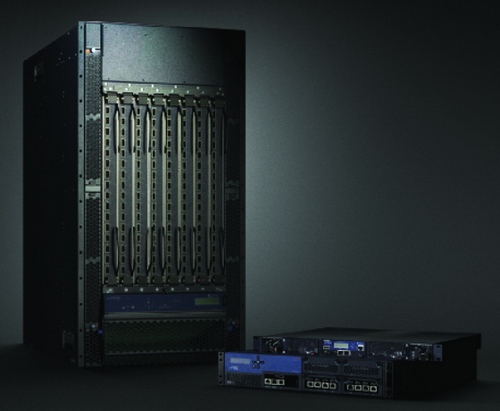
    The QFabric solution involves three core components. The QFabric node is the outer layer and it contains the logic to forward packets from one node to another. Nodes also form the distributed control plane for QFabric. The QFabric Interconnect is the mechanism which allows packets to flow from the ingress to the egress point on the switch. Finally there is the Director component which is what enables QFabric to be viewed and managed as a single switch.

    "QFabric allows all the compute and storage resources in the data center to be tied together into a single system," Yen said.

    The first QFabric product that Juniper is shipping is the QFX35000, a 64 port 10 GbE switch that also has Fiber Channel capabilities. Yen said the QFX will ship in the third quarter of 2011

    Thursday, December 23, 2010

    Project Stratus - Juniper lays out flat network roadmap

    From its position in the switching trenches, Juniper Networks has planned not one, but two ways to flatten legacy three-tier data center networks.

    Cisco vs. Juniper

    Juniper calls its approach the 3-2-1 data center network architecture, promoting the idea that enterprises can cut one tier out of their data center networks today and, ultimately, another.

    The result will be the flattest of all flat networks - a single layer operating as one giant switch.

    Juniper shared that ultimate vision, called Project Stratus, almost two years ago, but products aren't expected till 2011.

    A two-tier fabric

    In the meantime, enterprise network planners who see value in a flatter architecture can take advantage of a two-tier fabric using Juniper's Virtual Chassis technology.

    Applied at the access layer, Virtual Chassis technology allows up to 10 EX 4200 top-of-rack switches to operate and be managed as a single logical switch comprising hundreds - 480 in the case of the EX 4200 - of Gigabit Ethernet ports.

    Juniper also will have Virtual Chassis technology available on the EX 4500, a 48-port 10G Ethernet switch that will be available later this year or early next, says Calvin Chai, a director of enterprise marketing at Juniper.

    Enterprises can mix and match EX 4200 and 4500s, which also will support Converged Enhanced Ethernet and Fibre Channel over Ethernet (FCoE) for storage convergence, in the same Virtual Chassis fabric.

    "You still have your physical devices, but instead of using the traditional chassis-based model with a single chassis sitting in a rack and slotting in modules for ports, you can have these one-rack unit servers distributed throughout the data center. You can extend the Virtual Chassis fabric across floors, buildings or in the same rack using fiber connections," says Chai, noting a distance limitation of 50 kilometers.

    "And, you don't have to have 10 different uplinks from each of those switches. You just need one uplink because it behaves as one logical switch, so you're saving on port density and can collapse the core and aggregation layers - you simplify the network as you scale it up," he adds.

    "Juniper does have this nice, interesting twist with how it's pulling off this two-tier architecture by making it look like one machine," says Robin Layland, head of Layland Consulting, which specializes in network architecture and strategy for enterprise customers.

    A single network hop

    Further reducing complexity and bolstering performance would come with even more streamlining of the data center network architecture, Chai says. Juniper hasn't disclosed Stratus project details, but the goal is to collapse to a single layer that will provide connectivity from any point to any other point in a data center with one processing hop, he says.

    And don't be fooled by the "3-2-1" name, Chai says. Enterprises do not need to flatten the network progressively. An enterprise running a large three-tier data center network could go straight from there into a Stratus fabric, he says.

    "I don't dare use the word 'FDDI,' but it does sound like Juniper is planning to interconnect all these machines together and, in effect, form a super bus loop over the data center. Data would travel around the bus until the right machine pulls it off," says Layland, referring to an obsolete token-based networking technology. "We definitely don't want to say 'FDDI,' but you can ask all the same sorts of questions and bring up the same issues using new terms if we're essentially talking about a ring architecture."

    "One tier, two tier - are we talking 10-minute abs or seven-minute abs? It's really all up to the flexibility of the customer," says John Turner, director of networks and systems at Brandeis University, in Waltham, Mass., which is currently evaluating how best to handle a data center network refresh coming in 2011.

    Juniper has made Brandeis' short list of choices, as has Cisco. But Turner says he's made no final decision on how best to flatten the network in support of increased virtualization. Storage convergence is on his mind, too, but not a burning issue at this point.

    My Blog List

    Networking Domain Jobs