Network Enhancers - "Delivering Beyond Boundaries" Headline Animator

Showing posts with label Huawei. Show all posts

Thursday, September 22, 2016

Comparison of Routers Cisco, Juniper and Huawei


# Cisco, Juniper and Huawei Router comparison
# CCIE Candidates only
# MPLS requirement routers- High end Routers
# High Back-plane capacity and high port capacity
#Used as Core routers in the MPLS environment
# Cisco 9922- Capacity till 11 Tbps
# Juniper MX2020- Capacity till 80 Tbps
# Huawei NE5000E- Capacity till 6.4 Tbps

So below are the comparison between the various high end models in the market with the high capacity till in Tbps.

These kind of routers are basically used in the Service providers core. so we have many service providers who are providing MPLS, Internet services to the clients.

Service providers like AT&T, BT, Orange, NTT Communications, Verizon, Telefonica, TATA and so on used these kinds of routers in their core networks for high back-plane capacity.

Various features are supported by these kinds of routers like Multi-chassis ether-channel, Non-stop Forwarding, MPLS-TRR, Non-stop routing and various high end features.

Lets discuss the comparison in details as follows:-

Cisco firm will be presented by router Cisco ASR 9922. Given product backs up capacity 11 Tbps and this way it is the most productive product of ASR series.

For comparison in given article firm Juniper presents a model Juniper MX2020, which backs up carrying capacity from 34.4 to 80 Tbps.MX2020 supports a very high density 10GbE, 40GbE and 100GbE, interfaces, and also obsolete methods of connection SONET/SDH, ATM and PDH. It also supports subscribers’ management with wide-band connection, modern opportunities of time synchronizing and virtualization, which meet strict demands of mobile services.
Due to scalable in industry-leading set of opportunities the router MX2020 ideally suited for boarders and consolidated borders and net core and application cores as well.


Huawei represents model Huawei NE5000E. This very model in 2008 afforded the firm Huawei show itself to be arch-rival in the area of Internet backbone.NE5000E presents multi-level protection from the device to the network. For protection on the devices level, NE5000E contains passive plane where all key components of the device are switched in “hot-pluggable” and posses a function of hot back up. The solution contains nonstop address modification (NSF) on the basis of states and hot-swappable and nonstop routing (NSR) on the panel level and on the processes level in all scenario.


Wednesday, January 13, 2016

Huawei Threatens Cisco With Application Driven Networking


Huawei is pointing a gun straight at Cisco with a new strategy it's calling Application Driven Networking (ADN), designed to give comms networks the flexibility required for New IP applications.

Huawei Technologies Co. Ltd. announced its Application Driven Networking (ADN) without a lot of fanfare early last month. It sounds at first like a "me too" strategy that copies Cisco's similarly named Application Centric Infrastructure (ACI). (See Huawei Unveils Application-Driven Network Vision.)

But ADN is more than just a marketing campaign, as Ayush Sharma, senior VP and IP CTO for Huawei, explains it. It's an architecture that uses 5G principles to build networks with the flexibility needed for the different requirements of traditional voice, Internet and machine-to-machine communications.

While Cisco is building a virtual network overlay on top of MPLS and other traditional network components, Huawei is using open source, SDN, NFV and the 5G principles of network slicing to build programmable, network-agnostic networks on top of any media, including copper, fiber and wireless and LTE, Sharma tells Light Reading.

Carriers need to go beyond the old, simplistic definition of five-nines of reliability to meet the different demands of different kinds of applications, Sharma says.

For example, traditional voice networks follow the "Poisson distribution model," Huawei Fellow Wen Tong said in a statement. "Poisson Distribution" is a statistical model -- what it means for comms companies is that phone calls are likely to remain at a constant frequency and duration over time. This model is suitable for a hierarchical network architecture.

Internet communications follow a power-law distribution model, where most users are connected to central nodes.

And machine-to-machine communications comprises many different cases with greatly varying needs. For example, communications between connected cars requires extremely low latency. "In telemedicine, remote video systems require ultra-wide bandwidth, low latency and high reliability," Huawei says. "In this case, networks must create small systems locally and huge systems globally. The Markov distribution model supports network architecture with both distributed and centralized controls." (See How IoT Forked the Mobile Roadmap.)

These principles -- flexibility, applications driving technology and use of open components -- are hallmarks of New IP networks.

Huawei achieves the network flexibility required for the new generation of apps by dividing the network logically into the data plane, control plane and the services plane, where third-party applications such as the connected car, robotic surgery and drone control systems reside.

On the data plane (also known as the forwarding plane) the network uses programming languages such as Huawei's own Protocol Oblivious Forwarding, which is compatible with the industry standard P4, as well as OpenFlow, to forward traffic.

On the control plane, Huawei uses open protocols from ON.Lab 's ONOS andOpenDaylight to manage devices.

On the services plane, applications don't need to know anything about the underlying network complexity.


"Earlier, these kinds of things were vertically integrated into a box," says Sharma. A router contained forwarding, control and some network applications. Now the forwarding and control plane are separate devices built using standardized components and the applications reside anywhere on the network.

An example of Huawei's ADN in action is AT&T Inc. (NYSE: T)'s Central Office Re-architected as Data Center (CORD), a scalable, white-box architecture designed to deliver services more economically than the current central office set-up, incorporating multiple single-function boxes. Huawei is partnering with AT&T on CORD. (See AT&T to Show Off Next-Gen Central Office and Ciena Offers Hardened ONOS for Next-Gen Central Office Conversions.)

For another example, a connected car needs to be able to receive software upgrades, bug fixes and send reports from sensors. "They don't care whether it's over a fixed connection, WiFi, SDN or NFV. They need to be connecting, need a certain QoS, they don't care about implementation," Sharma says.


Monday, March 30, 2015

Huawei 6 months industrial training program-Cognitel

Monday, July 29, 2013

Huawei working to develop 5G technology


It can provide speed of 10 GBps, which is 100 times faster than the mobile technology used these days

As people across the world get used to the fourth generation (4G) mobile technology, Chinese equipment maker Huawei Technologies has said it is working on the fifth generation (5G), which is likely to be available for use by 2020.

The company said presently 200 people are working on the project and it has earmarked a specified amount for the research and development of the technology. It, however, refused to share details about the amount to be spent for the development of the technology.

Huawei Technologies official Wen Tong said that by 2020, there will be billions of connections and 5G can provide massive connectivity. The technology will enable people to have a fibre network like user experience on a wireless connection.

It can provide speed of 10 GBps, which is 100 times faster than the mobile technology used these days, Tong added.

South Korean giant Samsung has also announced that it has successfully tested 5G technology and it will be ready for commercial roll-out by 2020.

Mobile operators across the world have started moving towards the high-speed long term evolution (LTE) or 4G networks and Huawei provides equipment to 85 such networks.

The company is also undertaking a trial run to test the speed on its 4G technology on high speed MagLev train in Shanghai.

Huawei has deployed an LTE network to support wireless connectivity on the train, which runs between the centre of the Shanghai district to the International Airport. The total length of the track is 31 km and the train achieves a speed of up to 431 km per hour.

The company said on that speed, its 4G technology can provide a download speed of up to 50 MBps.


Friday, March 15, 2013

Huawei launches Global Network & Evolution Centre


Global information communications technology (ICT) services provider, Huawei has announced the launch of its first Global Network Evolution & Experience Centre (GNEEC). The GNEEC was specifically designed and developed to managed the challenges that operators encounter during the network evolution process. The GNEEC helps operators select the optimum network evolution offering that will meet the increasing demands of subscribers while minimising financial risks and generating higher return on investment. The GNEEC covers an area of 1,500 square metres and is equipped with an array of multi-generation E2E network systems with more than 200 sets of equipment supplied by eight mainstream vendors with specialties in all domains of the network infrastructure. Multi-vendor interoperability tests can be performed on over 30 kinds of network evolution plans, while independent testing and professional services areas can be configured to ensure the GNEEC can simulate and support all major evolution processes deployed in global markets.                


Wednesday, September 26, 2012

Huawei Targeting Cisco in Telepresence Market


The networking competition between Cisco and Huawei is now moving into the immersive video conferencing space, where Huawei is looking to displace Cisco as the top vendor.

Huawei Technologies, which already competes with Cisco Systems in the global networking market, reportedly is now looking to challenge Cisco in the telepresence space.
 
Cisco is the dominant player in the $2.8 billion immersive telepresence arena, leading other major rivals like Polycom. However, as Huawei looks to expand its capabilities beyond the networking business, telepresence is becoming a focus, Li Jun, general manager of such telepresence products at the Chinese vendor’s Enterprise unit, told Bloomberg News.
 
Huawei had about $200 million in sales of telepresence equipment in 2011, Li said.
 
Telepresence technology enables businesses to conduct conferences via video in an immersive fashion that gives participants the feeling of being in the same room, even though they may be across the world from each other. The equipment involved with telepresence systems can include not only the technologies, screens and cameras, but also furniture for the rooms.
 
Telepresence and other video conferencing technologies have gotten a boost in recent years as businesses look to increase employee productivity and improve the lines of communication with workers, partners and customers, while at the same time driving down travel costs. However, with the growth of such trends as cloud computing, bring your own device (BYOD) and greater workforce mobility, the video conferencing market is changing, with an increasing emphasis on software-based solutions and enabling video collaboration on a range of devices, including PCs and mobile devices like smartphones and tablets.
 
The uncertain global economy and reduced spending in the public sector are conspiring to slow sales of video conferencing solutions overall, and the market for immersive telepresence products is being particularly hard hit, according to analysts at IDC. In the second quarter, overall video conferencing spending fell 10 percent from the same period in 2011, while revenue in the multi-codec telepresence dropped fell 38.4 percent. Those numbers were a continuation of the trend seen in the first quarter, according to IDC.
 
“The high-end, immersive telepresence market has been taking a hit lately as lower-cost, HD-quality video solutions, along with a range of new video deployment options for customers, have emerged," Rich Costello, senior analyst for IDC’s Enterprise Communications Infrastructure business, said in a statement in May when announcing first-quarter market numbers.
 
Still, Huawei executives see telepresence technology as a key part of their plans to triple revenue to $100 billion by 2021, up from $32 billion in 2011. Huawei also is looking to push its way into other markets as well, including cloud computing and mobile devices such as smartphones and tablets.
 
Li indicated to Bloomberg that Huawei will look to offer less expensive telepresence systems as it competes with Cisco. The company’s high-end telepresence offering, the TP3106, delivers high-definition images across three flat screens for about $160,000, while a similar system from Cisco could cost as much as $300,000 Li said.
 
Cisco executives have acknowledged Huawei as a strong rival in the networking space. In April, Cisco CEO John Chambers told The Wall Street Journal that he saw Huawei—rather than the likes of Hewlett-Packard and Juniper Networks—as its top competitor. That came after Huawei in 2011 launched an aggressive campaign to increase its presence in the North American market.


Friday, September 21, 2012

Huawei previews Cisco-killin' E9000 modular system


Pulling the telecom-to-datacenter California alley-oop
 
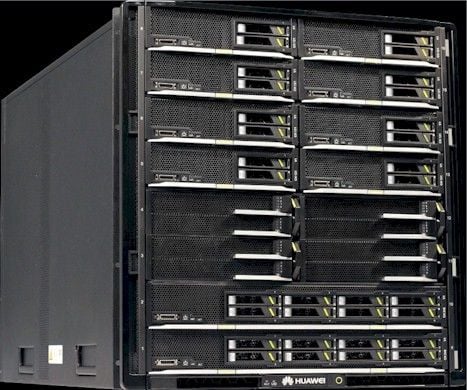
Chinese telecom giant and increasingly important server player Huawei Technologies is moving from racks and blades into modular designs that use a mix of both approaches – and look very much like modular kit from Cisco Systems, IBM, and Hitachi, as well as the newer bladish iron from HP and Dell.
 
The likeness between the forthcoming Huawei servers and IBM and Hitachi machines announced back in April is enough to make you wonder if Huawei is actually manufacturing those companies' respective Flex System and Compute Blade 500 machines.
 
Huawei isn't – as far as we know – but as El Reg pointed out when Hitachi announced the CB500 machines, it sure does look like IBM and Hitachi are tag-teaming on manufacturing for modular systems. Possibly by using the same ODM to bend the metal and make the server node enclosures, perhaps?
 
The distinction between a blade and a modular system is a subtle one. With modular systems, server nodes are oriented horizontally in the chassis and are taller than a typical vertical blade is wide, allowing for hotter and taller processors as well as taller memory and peripheral cards than you can typically put in a skinny blade server.
 
The modular nodes can be half-width or full-width in the chassis and offer the same or slightly better compute density as a blade server in a similar-sized rack enclosure, and because of the extra room in the node, can accommodate GPU or x86 coprocessors as well. They are made for peripheral expansion and maximizing airflow around the nodes.
 
Modular systems generally have converged Ethernet networks for server and storage traffic, but also support an InfiniBand alternative to Ethernet for server networks and Fibre Channel for storage networks, just as do blade servers. Modular systems also tend to have integrated systems management that spans multiple compute node enclosures and are geared for virtualized server clouds. It's not a huge difference, when you get right down to it.
 
What is most important about modular systems, in this evolving definition, is that they look like – and compete with – the "California" Unified Computing System machines that Cisco put into the field three years ago when it broke into the server racket.
 
Cisco's business has been nearly doubling for the past two years and is bucking the slowdown big-time in serverland. Cisco is defining the look of the modern blade server and eating market share. Huawei wants to pull the same California maneuver, peddling its own servers to its installed base of networking and telecom gear customers and driving out the server incumbents.
 
Huawei lifted the veil on the Tecal E9000 modular machines at the Huawei Cloud Congress show recently in Shanghai, and says that the boxes won't actually ship until the first quarter of next year – Huawei is clearly not in any kind of a big hurry to get its Cisco-alike boxes out the door.
 
The Tecal E9000 modular system from Huawei
 
The Tecal E9000 is based on a 12U chassis that can support either eight full-width nodes or sixteen half-width nodes. The chassis has 95 per cent efficient power supplies, and a total of six supplies can go into the enclosure with redundant spares, rated at 3,000 watts a pop AC and 2,500 watts a pop DC.
The chassis and server nodes have enough airflow that they can operate at 40°C (104°F) without additional water blocks or other cooling mechanisms on the chassis or the rack. This is the big difference with modular designs, and one that was not possible with traditional blades. Blade enclosures ran hot because they were the wrong shape, and the fact that by simply reorienting the parts you can get the machines to have the same computing capacity in the same form factor just goes to show you that the world still need engineers.
 
The Tecal E9000 server nodes are all based on Intel's Xeon E5-2600 or E5-4600 processors, which span two or four processor sockets in a single system image, respectively. There are a couple server node variants to give customers flexibility on memory and peripheral expansion. The nodes and the chassis are NEBS Level 3 certified (which means they can be deployed in telco networks) and also meet the European Telecommunications Standards Institute's acoustic noise standards (which means workers won't go deaf working on switching gear).
 
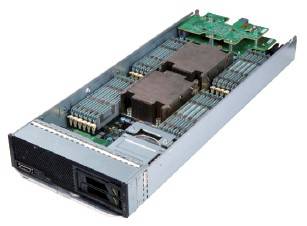
The Tecal CH121 server node
 
The Tecal CH121 server node
 
The CH121 is a single-width server node with two sockets that can be plugged with any of the Xeon E5-2600 series processors, whether they have four, six, or eight cores per socket. Each socket has a dozen DDR3 memory slots for a maximum capacity of 768GB across the two sockets using fat (and crazy expensive) 32GB memory sticks.
 
 
The node has two 2.5-inch disk bays, which can be jammed with SATA or SAS disk drives or solid state disks if you want lots of local I/O bandwidth but not as much capacity for storage on the nodes. The on-node disk controller supports RAID 0, 1, and 10 data protection on the pair of drives.
The CH121 machine has one full-height-half-length PCI-Express 3.0 x16 expansion card and two PCI-Express 3.0 x16 mezzanine cards that plug the server node into the midplane and then out to either top-of-rack switches through a pass-through module or to integrated switches in the E9000 enclosure.
 
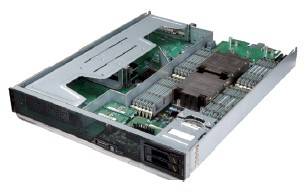
The CH221 takes the same server and makes it a double-wide node, which gives it enough room to add six PCI-Express peripheral slots. That's two x16 slots in full-height, full-length form factors plus four x8 slots with full-height, half-length dimensions.
 
The expanded Tecal CH221 server node
 
The double-wide Tecal CH221 server node
 
A modified version of this node, called the CH222, uses the extra node's worth of space for disk storage instead of PCI-Express peripherals. The node has room for the same two front-plugged 2.5-inch drives plus another thirteen 2.5-inch bays for SAS or SATA disks or solid state drives if you want to get all flashy. These hang off the two E5-2600 processors, and the node is upgraded with a RAID disk controller that has 512MB of cache memory and supports RAID 0, 1, 10, 5, 50, 6, and 60 protection algorithms across the drives. This units steps back to one PCI-Express x16 slot and two x16 mezz cards into the backplane.
 
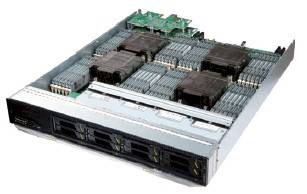
If you want more processing to be aggregated together in an SMP node, then Huawei is happy to sell you the CH240 node, a four-socket box based on the Xeon E5-4600. Like other machines in this class from other vendors, the CH240 has 48 memory slots, and that taps out at 1.5TB of memory using those fat 32GB memory sticks. The CH240 supports all of the different SKUs of Intel's Xeon E5-4600 chips, which includes processors with four, six, or eight cores.
 
The Tecal CH240 server node
 
The Tecal CH240 four-socketeer
 
The CH240 does not double-up on the system I/O even as it does double-up the processing and memory capacity compared to the CH221. It has the two PCI-Express x16 mezzanine cards to link into the midplane and then out to switches, but no other peripheral expansion beyond that in the base configuration.
 
 
This is a compute engine in and of itself, designed predominantly as a database, email, or server virtualization monster. It supports the same RAID disk controller used in the CH221, but because of all that memory crammed into the server node, there's only enough room for eight 2.5-inch bays for disks or SSDs in the front. If you want to sacrifice some local storage, you can put in a PCI-Express riser card, which lets you put one full-height, 3/4ths length x16 peripheral card into the CH240.
All of the machines are currently certified to run Windows Server 2008 R2, Red Hat Enterprise Linux 6, and SUSE Linux Enterprise Server 11, and presumably will be ready to run the new Windows Server 2012 when they start shipping early next year.
 
VMware's ESXi 5.X hypervisor and Citrix Systems' XenServer 6 hypervisor as well, and again, presumably Hyper-V 3.0 will get certified on the box at some point and maybe even Red Hat's KVM hypervisor as well. There is no technical reason to believe that the server nodes can't run any modern release of any of the popular x86 hypervisors, but there's always a question of driver testing and certification.
 
 
The CX series of switch modules for the E9000 enclosure
 
 
On the switch front, Huawei is sticking with three different switch modules, which slide into the back of the E9000 chassis and provide networking to the outside world. The CX110, on the right in the above image, has 32 Gigabit Ethernet ports downstream into the server midplane and out to the PCI-Express mezz cards, which is two per node. The CX110 switch module has a dozen Gigabit and four 10GbE uplinks to talk to aggregation switches in the network.
 
The CX311 switch module takes the networking up another notch, with 32 10GbE downstream ports and sixteen 10GbE uplinks. This switch also has an expansion slot that can have an additional eight 10GbE ports or eight 8Gb/sec Fibre Channel switch ports linking out to storage arrays.
Huawei also has a QDR/FDR InfiniBand switch model with sixteen downstream ports and eighteen upstream ports, which can run at either 40Gb/sec or 56Gb/sec speeds.
 
The current midplane in the E9000 chassis is rated at 5.6Tbit/sec of aggregate switching bandwidth across its four networking switch slots, which can be used to drive Ethernet or InfiniBand traffic (depending on the switch module you choose).
 
Here's the important thing: the Tecal E9000 midplane will have an upgrade option that will allow it to push that enclosure midplane bandwidth up to 14.4Tb/sec, allowing it to push Ethernet at 40 and 100 Gigabit speeds and next-generation InfiniBand EDR, which will run at 100Gb/sec; 16Gb/sec and 32Gb/sec Fibre Channel will also be supported after the midplane is upgraded. It is not clear when this upgraded midplane will debut.
 
Pricing on all of this Tecal E9000 gear has not been set yet, according to Huawei. ®


Wednesday, September 12, 2012

Huawei launches virtual desktop in a box


Desktop box connected to cloud aimed at SMEs.

Chinese comms company Huawei has launched three new virtual desktop products aimed at small and medium-sized enterprises.
 
The Desktop Cloud M1 (mini Desktop Cloud), Desktop Cloud A1 and A2 are based on Huawei’s proprietary cloud operating system and cloud management system software and integrates Huawei’s server IT hardware infrastructure, including servers, networks and storage.
 
The company said that the integrated systems are aimed at enterprises looking to deploy cloud-based desktop systems as well as reducing IT costs and increasing flexibility and efficiency.
 
Huawei Desktop Cloud M1 is a virtual desktop infrastructure (VDI) in-a-box, designed for SMEs. It said that during product development process, the company focused on balancing SMEs’ IT application and management capabilities with the overall product performance, cost and user experience.
 
It said as a result, this meant the product could reduces cost and resource demands for deployment and operation. On the back end, the system connects to Huawei’s RH2288 server to use local storage to achieve an integrated Huawei desktop cloud platform, with one server supporting 100 users.
 
It claimed that when compared to traditional VDI solutions, the system achieved more than 50 per cent savings on the initial investment costs. It said these savings were achieved through centralised deployment and visual, automated operation and maintenance. It claimed deployment times of the desktop were less than an hour.
 
Its two other systems, Desktop Cloud A1 and A2, use the firm's GalaxEngine cloud operating system and GalaxManager cloud management software to give organisations "an integrated architecture of hardware and software for the unified, automated and dynamic management of virtual computing, virtual networks and virtual storage resources".
 
Huawei Desktop Cloud A2 is a high-density integrated desktop cloud converged infrastructure mounted on a 2-meter cabinet. A single cabinet can support 1,000 users, with the system supporting a maximum of 3,000 users. Huawei’s desktop cloud converged infrastructure enables system pre-installation to allow for instant on-site deployment with just one click. Users can manage the entire system with operation and maintenance software, allowing for automation and flexibility in service deployment.
Zhang Xiaosong, Marketing Operations Director of IT Product Line at Huawei said that desktop cloud is an important component of its cloud computing strategy.
 
"Huawei’s desktop cloud solutions have already been deployed commercially across various industries in 33 countries globally, including government, enterprise, energy, finance and education," he said.
 
"As ICT integration for enterprises grows and evolves, we are confident that Huawei will continue to be well-positioned as their partner of choice for desktop cloud deployments,” said Xiaosong.
 

Monday, September 10, 2012

Huawei To Unveil £1.2bn UK Investment

At least 700 jobs will be created through Chinese telecoms equipment-maker Huawei's £1.2bn investment in the UK.

The Chinese telecoms equipment-maker Huawei will tomorrow hand David Cameron a post-Olympics trade boost by unveiling a £1.2bn investment plan to accelerate the growth of its British business.

I can reveal that Huawei, one of China’s largest - and most contentious - private companies, will pledge to create at least 700 jobs in the UK during the next five years while directly investing £600m in growing its operations in Britain.

A further £600m-benefit to the economy will be generated from procurement activity related to the direct investment activity, the company is expected to announce.

I understand that Mr Cameron is expected to endorse the news, hailing it as evidence that Britain's attractiveness as an investment destination is increasing in the wake of a successful summer hosting the Olympic and Paralympic Games.

Huawei is also expected to outline further details of plans to strengthen ties with British universities through an internships programme, as well as spelling out how it can offer British companies access to the giant Chinese market.

The news of Huawei's investment, which will be among the largest in Britain so far this year, will coincide with a rare visit to Britain by Ren Zhengfei, the company's founder.

Huawei is one of an emerging breed of Chinese companies which are becoming genuine challengers to established Western rivals. It recently overtook Sweden's Ericsson to become the world’s biggest telecoms equipment-manufacturer.

It has been dogged, though, by unproven - and frequently denied - allegations that it is a front for China’s People’s Liberation Army because of Mr Ren’s past as an engineer in the country's armed forces.

Huawei has in recent years seen expansion in Australia, India and, most notably, the US blocked by governments which have voiced fears that the Chinese company could be aiding cyber-attacks on technological infrastructure elsewhere in the world.

Such concerns have been dismissed by the company as examples of protectionist paranoia.

Unlike most large Chinese enterprises, Huawei is entirely privately-owned, with 65,000 of its 140,000 employees worldwide its only shareholders.

Huawei has taken a number of steps to allay concerns about its business activities, appointing a board of senior British businesspeople to advise it, including Baroness Wheatcroft, the former journalist, Andrew Cahn, the former head of UK Trade & Investment, and Brian McBride, ex-managing director of Amazon.co.uk.

It also operates a Cyber Security Evaluation Centre in Oxfordshire which works with GCHQ, the Government's signals intelligence agency, to ensure the integrity of the equipment it sells in Britain.

A design centre in London, which will be set up shortly, is also part of Huawei's future investment plans in the UK.

The company already counts all of the major UK broadband and smart-phone operators, including BT, TalkTalk and Vodafone, among its clients, and is attempting to make significant inroads into the enterprise solutions market for small and medium-sized business customers.

Seven years ago, it failed with a bid for Marconi, the struggling British manufacturer, the bulk of which was eventually subsumed into Ericsson.

A spokesman for Huawei's UK business declined to comment on Monday evening.

Friday, August 24, 2012

Huawei commercially launches Blade RRU solution


Huawei, a global leading information and communications technology (ICT) solutions provider, has launch launched Blade Remote Radio Unit (RRU) solution commercially.


The Blade RRU is part of Huawei’s distributed base station solution, which supports the assembly of different bands to meet operator multi-band, multi-technology network deployment requirements. The solution’s modular, scalable design constitutes an innovative industry breakthrough.

As mobile broadband develops, operators continue to expand and upgrade networks to meet growing data traffic demands. Wireless network deployment is now required to support multiple technologies and bands, while site acquisition becomes increasingly difficult. The Huawei Blade RRU solution reduces the total volume of RRU equipment, enhances installation flexibility, simplifies operations and maintenance, and simultaneously supports multi-technology, multi-band networks with limited site resources and costs.

The Blade RRU solution’s design constitutes a breakthrough in industry innovation. The volume of a single RRU is an industry-leading 12L, which is half the industry average. For flexible network deployment, multiple RRUs are seamlessly assembled as “one box” with independent installations and maintenance for each unit, meaning that this single entity of assembled RRUs supports multi-band, multi-mode GSM/UMTS/LTE, multi-sector, multi-carrier and multiple-input/multiple-output (MIMO) technology in accordance with evolving network development requirements.

The Blade RRU solution enables rapid network deployment and expansion, easy operations and maintenance, and flexible network upgrades and expansions to help bring business success for operators.
 

Thursday, August 23, 2012

Vodafone Names Huawei 'Supplier of the Year 2012'

 
Huawei, a leading global information and communications technology (ICT) solutions provider, today announced that it has been awarded Vodafone's Supplier of the Year.
 
 
The award was presented by Detlef Schultz, Global Supply Chain Management Director and CEO, Vodafone Procurement Company (VPC) at the annual Vodafone Supplier Conference.
 
Huawei won the award in recognition of its spirit of strategic partnership with Vodafone and the competitive products and services that Huawei has delivered to Vodafone. As of July 2012, Huawei and Vodafone are working together in more than 20 countries. Continuous improvement and innovation are important components of Vodafone's Supplier Performance Management Programme, which evaluates supplier performance regularly and in which Huawei consistently performs well.

Huawei Licenses Metaswitch Control Plane

 
Metaswitch today announced an expansion of its ten-year technology relationship with Huawei, a leading global information and communications technology (ICT) solutions provider, to include licensing of DC-PCE, Metaswitch’s Path Computation Element software.
 
Metaswitch’s DC-PCE, along with its GMPLS software previously licensed to Huawei, provides the key building blocks for Huawei’s Unified Control Plane, which powers the software for its SingleBackbone network architecture. Huawei’s SingleBackbone solution enables the convergence of IP and optical networks, which dramatically improves network efficiency and reliability while lowering operational costs and provisioning times.
 
“The control plane plays an important role in our IP & OTN Synergy strategy,” said Daniel Xiong, vice president of research and development of Huawei’s Transmission Network Product Line. “Our relationship with Metaswitch provides us with access to the latest innovations in this space and we expect DC-PCE to be an important component of carrier networks as they move to SDN-based architectures.”
 

Wednesday, August 22, 2012

Huawei Dorado5100 Demonstrates Outstanding SPC-1 Performance


Huawei, a leading global information and communications technology (ICT) solutions provider, announced that its Solid State Storage (SSS) product, OceanStor Dorado5100, has produced an outstanding SPC-1(SPC Benchmark 1) Result. As one of the critical products in Huawei’s SSS strategy, the Dorado5100 adopts full-SSD architecture to meet the demanding storage performance requirements from enterprise business systems. The results were released via the official SPC website on August 14, 2012.

The record performance of 600,052.49 SPC-1 IOPSTM with an average response time of 1.09 ms, has established Dorado5100 as a performance leader in the storage industry. As a full-SSD array featuring the top I/O speed, the Dorado5100 maximally meets the demanding storage requirements for latency-sensitive services such as large-scale databases, high-performance computing, and VDI(Virtual Desktop Infrastructure).

The Dorado5100 helps data centers coordinate internal data as quickly as possible to deliver immediate response and maximize overall efficiency. Incorporating dual-controller full-redundancy architecture, the Dorado5100 offers excellent data protection by eliminating single points of failure and achieving up to millions of hours of MTBF(Mean Time Between Failure), effectively safeguarding service continuity.

"Huawei is committed to customer-centric technical innovation and our solutions are designed specifically to meet customer requirements. Combining Huawei’s proprietary intellectual property rights with its storage expertise, our company has developed a suite of comprehensive and industry-leading products," said Fan Ruiqi, President of Huawei Storage Product Line. "High performance, availability, and ease-of-use are what we have strived for, and this is reflected in our outstanding SPC-1 result, a strong example of our competitive edge."

The Dorado5100 features super flexibility and delivers customizable services and technical support for enterprises of all sizes. Benefiting from the advanced high-speed cache management and I/O scheduling algorithm, the Dorado5100 offers immediate response in a complex computing environment and becomes an optimal choice for key services such as large-scale OLTP/OLAP databases, finance, online transaction, and video editing.

Legal Statement
SPC, SPC-1, and SPC-1 IOPS are trademarks or registered trademarks of SPC. Huawei and OceanStor are trademarks or registered trademarks of Huawei Technology Co., Ltd. All other trademarks are property of their respective owners

Tuesday, August 21, 2012

Huawei Launches eNSP, an Advanced Product Facilitating Your Way to Becoming a Technical Expert


Huawei, a leading global information and communications technology (ICT) solutions provider, recently announced the launch of a free graphical enterprise network simulation platform (eNSP) for ICT practitioners and those who want to grasp knowledge about ICT. This platform can simulate such real network devices as routers and switches to help ICT practitioners and customers become more familiar with Huawei's datacom products, grasp the operations and configurations of Huawei's routers and switches, and master fault locating methods. The platform also helps ICT practitioners and customers possess and improve the capabilities to plan, construct, operate, and maintain ICT networks for enterprises and thus helps enterprises build better networks with enhanced efficiency.

In recent years, more and more ICT practitioners require the ability to simulate real network devices without actually using these devices. As a result, ICT vendors have developed simulation platforms based on their own devices. However, the current simulators have some common problems: low-fidelity simulation, delayed system upgrade, and software that is hard to operate. ICT practitioners have been beset by these problems, which have affected user experience in simulating routers and switches. These frustrations and problems have turned many practitioners away from learning about relevant products because they could not experience the operations first-hand with true-to-deployment simulations.

Recently, Huawei developed a user-friendly datacom device simulator that delivers high-fidelity simulation: The Huawei enterprise network simulation platform (eNSP). This platform runs Huawei's Versatile Routing Platform (VRP) system and can simulate deployments before real devices are deployed in a network and simulate tests on the compatibility and configurations of the devices, thereby helping practitioners facilitate pre-deployment planning and testing on high-quality ICT networks for enterprises. Huawei eNSP supports interconnection to real devices and can realize real-time packet capture analysis, enabling you to fully understand the principles of networking protocols and explore network technologies within the safe bounds of a simulator. Furthermore, the eNSP tool allows ICT practitioners to pass Huawei Certification in many domains by simulating the tests for Huawei Certified Datacom Associate (HCDA), Huawei Certified Datacom Professional (HCDP)-Enterprise, Huawei Certified Internetwork Expert (HCIE)-Enterprise, thereby allowing rookies to become technical experts.

The launch of the free eNSP will provide an opportunity for all to experience the benefits of Huawei's equipment. Huawei is confident that all who experience this tool will benefit from it; whether they are a student who wants to pass Huawei's certification, an instructor who gives lectures on network technologies, or a technical engineer who operates datacom products or maintains live networks.

Tuesday, August 14, 2012

Who’s afraid of Huawei?

The rise of a Chinese world-beater is stoking fears of cyber-espionage. Techno-nationalism is not the answer

CHINESE companies have started to win first place in global markets. Huawei has just overtaken Sweden’s Ericsson to become the world’s largest telecoms-equipment-maker. Even though many foreigners still cannot pronounce its name (some call it “Hawaii”, and the firm has even produced a video teaching people to say hwah-way), Huawei is becoming an increasingly powerful global player, capable of going head-to-head with the best in intensely competitive markets. It follows Haier, which is already the leading white-goods-maker; now Lenovo is challenging Hewlett-Packard as the world’s biggest PC-maker. Plenty more will follow (see article).

Huawei, a private firm, is a standard-bearer in China’s long march into Western markets. Its founder, Ren Zhengfei, who served as an engineer in the People’s Liberation Army (PLA), at first struggled to win customers even in China. But his company followed Mao’s strategy of using the countryside to encircle and capture the cities, and it has moved on to win foreign markets too: in Europe it is involved in over half of the superfast 4G telecoms networks that have been announced, and it has become a strong competitor in mobile phones (see article). The company is now a $32-billion business empire with 140,000 employees, and customers in 140 countries. It commands respect by delivering high-quality telecoms equipment at low prices.

They did it Huawei

But Huawei inspires fear too—and not just among its competitors. The company is said to be too close for comfort to the PLA. Westerners fret that the networks the firm is building are used by Chinese spooks to eavesdrop during peacetime and could be shut down suddenly during wartime. They see the firm as a potent weapon in China’s burgeoning cyber-arsenal.

It is a view that some governments are taking seriously. Earlier this year Australia blocked Huawei’s participation in a scheme to build a national broadband network in the country. The company has also faced opposition to its commercial expansion in India. And in America, where Huawei’s attempts to grow have often been stymied, a congressional committee that focuses on intelligence matters is putting the firm under a microscope; suspicions have been aggravated by a recent spate of cyber-attacks attributed to Chinese hackers.

Western governments are also suspicious of the subsidies, low-interest loans and generous export credits lavished on favoured champions, including Huawei. The European Commission is considering opening an investigation. Some people suppose that the Chinese government is helping Huawei win overseas contracts so that spies can exploit its networks to snoop on ever more of the world’s electronic traffic.

Arguments against imports always need to be viewed with caution, since they will be used by protectionists to keep emerging rivals out. Still, it is reasonable to worry about security in telecoms: recent reports have pointed to the efforts of Chinese state-sponsored hackers to vacuum up valuable Western commercial secrets on a massive scale. Western intelligence agencies are also alert to the risks of eavesdropping and cyber-attacks because they themselves are practitioners (a prime example being the Stuxnet virus, aimed at Iran’s nuclear programme). As for Huawei, a firm that controls a network’s creation and management is ideally placed to sneak in malware and sneak out sensitive data. Even though it is a private company with an awful lot to lose if it were caught spying, the power of the state in China’s version of capitalism means the West is right to be vigilant.

But banning Huawei from bidding for commercial contracts is wrongheaded, for two reasons. One is that the economic benefit of competition from China in general and Huawei in particular is huge. It boosts growth and thus wellbeing. Huawei’s cheap but effective equipment helped make Africa’s mobile-telecoms revolution possible.

Distrust and verify

The other reason for not banning Huawei is the dirty little secret that its foreign rivals strangely neglect to mention: just about everybody makes telecoms equipment in China these days. Chinese manufacturers and designers have become an integral part of the global telecoms supply chain. Blocking Huawei (or its rival Chinese telecoms giant, ZTE) while allowing gear from, say, Alcatel-Lucent or Ericsson on a network may make politicians feel good. But it is no guarantee of security. Huawei’s competitors have a vested interest in hyping concerns about it, while disguising their own reliance on Chinese subcontractors and on subsidies.

The answer is to insist on greater scrutiny all round, not just of Chinese firms. Governments should be crystal-clear about what conditions telecoms firms need to meet to win business—something America’s secretive security-review process does not do today. They should also do more to ensure that equipment is secure, no matter who makes it. That means demanding to know where hardware components and software come from, and requiring intrusive random inspections of code and equipment. America has no effective system of supply-chain checks. In Britain, by contrast, where BT is a big customer, Huawei has established a unit (run in close co-operation with GCHQ, Britain’s signals-intelligence agency) with security-cleared personnel, including former employees of GCHQ, who vet gear from China before it is installed. Such scrutiny will drive up costs, but these pale in comparison with those imposed by bans on Chinese firms, which diminish competition and push up prices.

Huawei can also help allay foreigners’ fears. The company’s opaque ownership structure and secretive culture have damaged its reputation. It needs to be far more open. One way to achieve this would be for the closely held firm to seek a listing on a global stockmarket—if not in America, then at least in Hong Kong. Greater openness would also help clarify the real threat that Chinese firms such as Huawei pose to America and other countries: that they are starting to out-innovate the home-grown competition.

Tuesday, July 10, 2012

Huawei eyes deals with Etisalat, Saudi Telecom

China's Huawei Technologies is in talks with Gulf telcos Etisalat and Saudi Telecom to manage their fixed-line networks, an executive said, potentially cementing its leadership of a $1 billion regional industry.

Huawei, the world's No.2 telecom gear maker, is in similar negotiations with several other Middle East operators, the executive said in emailed comments, but declined to name them, citing confidentiality agreements.

"Huawei has strong partnerships with most regional operators and is constantly looking into ways of expanding these," Xia Chaojie, vice-president for delivery and service, Huawei Middle East, told Reuters.

"We see an opportunity to do this through moving towards new technologies and also looking at fixed-line managed services. Our teams have initiated talks with all our fixed network partners in the Middle East, including operators like Saudi Telecom and Etisalat."

Etisalat is a former monopoly in the United Arab Emirates, while managed services refers to operators outsourcing maintenance of networks to a third party.

The practice is increasingly common in the Middle East, allowing operators to better focus on marketing and customer services as a means of differentiating themselves from competitors.

Outsourcing network maintenance also typically cuts telcos' operating costs by 13 to 20 percent, Xia said.

He estimated the Middle East's managed services sector was worth $1 billion last year, claiming Huawei's market share was 55 percent. And he forecast sector revenue would grow around 18 percent over the next two to three years.

"In the Gulf we are providing or have provided managed services partnerships with almost all of the major operators," he said.

These include long-term deals with Oman's Nawras NWRS.OM, a unit of Qatar Telecom QTEL.QA, Saudi Arabia's Mobily 7020.SE -- part-owned by Etisalat -- and UAE's du DU.DU.

Huawei and domestic rival ZTE Corp have come to prominence in the past few years, clinching contracts with major carriers and often edging out European rivals Ericsson, Alcatel Lucent SA and Nokia Siemens Networks.

Huawei is also helping to build and operate high-speed Long-term Evolution (LTE) mobile networks for Saudi Arabia's three operators, plus Etisalat, Nawras and Oman Telecommunications Co OTL.OM (Omantel).

LTE is specifically designed to carry data rather than voice and potentially offers download speeds more than double that of 3G, which it will eventually supersede, although a lack of LTE-enabled handsets means consumer adoption has been slow.

Huawei launches public cloud solution and innovation center

Huawei, a leading global information and communications technology (ICT) solutions provider, today officially launched its Telco Public Cloud solution and Public Cloud Services Innovation Center at the Huawei Cloud Innovation Forum at CommunicAsia 2012 in Singapore.


Huawei’s Telco Public Cloud solution enables operators to provide SLA (Service-Level Agreement) guaranteed services such as Infrastructure as a service (Iaas) and Software as a service (Saas) to end users through Huawei managed services. Integrating servers, storage and other IT infrastructure, as well as pre-integrated corporate office and business application software, Huawei Telco Public Cloud Services unify and effectively manage resources from cooperative Independent Software Vendors (ISV). Cloud Service Brokerage (CSB), a core component of the technology, has been recognized by a number of well-known local enterprises currently using the Public Cloud services provided by Huawei.


To support its Public Cloud solution, Huawei also launched a Cloud Services Innovation Center during the forum. Through the center, Huawei is able to provide IT resources such as computing and storage, as well as integrate industry leading corporate office application software from Microsoft, ORACLE, and Kingdee.


Operators around the world can logon to the center’s website for access to small scale commercial operation of public cloud, enabling them to accumulate operating experience, and further understand customer demands and business models. In addition, carrier operator’s customers can also register through the self service function to benefit from real life experiences and case studies from the facilities utilizing public cloud services.

Huawei gets entry into CERN

Huawei, a leading global information and communications technology (ICT) solutions provider, has said that its cloud storage system has passed the performance test of the European Organization for Nuclear Research (CERN), world's largest particle physics laboratory. With this, the telecom major has become a contributing member to CERN openlab.

CERN openlab was created to develop innovative and advanced IT systems to be used by the LHC community through bringing together the efforts of science and industry. The scalability of the storage system is important for CERN as the laboratory faces the increasing demands of its physics users. The massive data growth prompts CERN to evaluate new storage technologies. Huawei, with industry-leading storage experts and a significant technical experience, is committed to the development of innovative storage solutions in the field of next-generation cloud storage.

In early 2012, Huawei's cloud storage system was delivered to the CERN site, and in three months, the installation and benchmark performance evaluation were completed. Huawei's cloud storage proved to show excellent data writing and reading performance in large-scale data environments, with horizontal scalability. The system also provides a self-healing intelligent maintenance, which significantly reduces maintenance costs, and effectively enhances the storage system's availability and reliability. The test validation results demonstrate this innovative hardware and software architecture complies with the mass storage requirements.

Saturday, June 23, 2012

Huawei has High Hopes in Managed Services

To Huawei Technologies, managed services is more than just a market segment, it’s an opportunity to accelerate sales and market share, and it wants a bigger share of that growing and lucrative market.


Around the world, Huawei is snapping up major managed services contracts with telecommunications companies and service providers. The foundation of these engagements is the technology has become too complicated for these companies to manage on their own. Outsourcing management and administration to Huawei frees the subscriber to focus on core business development and innovation.

Already, Huawei has more than 240 major managed services contracts in 60 countries. Most recently, Huawei capture contracts with Sunrise, Telefonica UK and SingTel. According to the China-based company, its managed services growth is 70 percent over the last six years.

The strategy and value proposition is essentially the same as Cisco’s Smart Net Total Care, which aims to provide Cisco and partner-led technology implementation and managed services support to telecom companies and service providers. Cisco is already generating more than $8.7 billion a year, and sees even greater room for expansion.


While many question the viability of managed services in the cloud era, companies like Cisco and Huawei are seeing tremendous opportunity in moving beyond offloading to true business augmentation. And they’re not the only ones. Numerous solution provider and systems integrators, such as Dimension Data are making similar moves.

Even though the Chinese company is one of the world’s largest equipment manufacturers, it remains mostly a fabrication provider to other tech vendors rather than a fulfillment company. It wants to break out of white box manufacturing model and become a true IT vendor on the global stage. Managed services on the service provider level is seen as an accelerator to that goal.

What Huawei lacks is a true managed services strategy to enable partners down the channel stack to deliver services to midmarket and SMB accounts. Cisco has been doing managed services enablement for years, providing MSPs access to its technology stack and granting price protection to MSPs that standardize on their equipment.

As Huawei dives deeper into managed services it may find the lure of the midmarket channel too tempting to resist, and could develop programs that enable others to provide managed services on its platform.

Tuesday, May 3, 2011

Huawei launches 200G line card for routers

To deploy ultra-broadband networks over which users can enjoy high-quality cloud computing, mobile broadband and HD video services

Huawei, a provider of telecommunications network offerings, has launched 200G line card for high-end router.

The high-performance line card strengthens Huawei's router clustering capabilities and will enable operators to deploy ultra-broadband networks over which users can enjoy high-quality cloud computing, mobile broadband and HD video services.

The deployment of the new 200G line card enables higher network and power efficiency for operators to effectively increase bandwidth, while reducing operation and maintenance (O&M) costs.

The new offering uses Huawei's Solar chipsets including high performance forwarding engine chipset, switch fabric chipset, traffic management chipset, and the new-gen energy-saving technologies as MIP (Macro Instruction for Packet Processing).

The above chipsets allows the 200G line card to achieve line-rate forwarding of services and maintain minimum power consumption lower than 2.62 W per GE, the company claimed.

Huawei carrier IP sub-product line president Hu Kewen said operators demands for larger-capacity ultra-broadband networks to carry high-value services is the essential drive behind their development of the 200G line card.

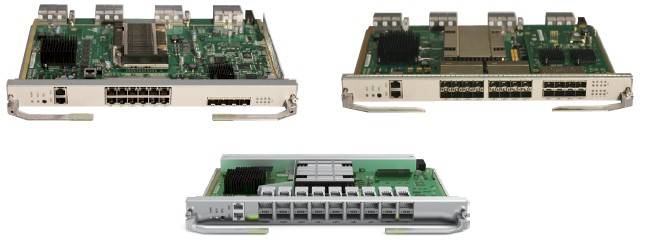
The 200G line card, consisting of a mother card and daughter card, will be delivered with two types: 2 x 100GE and 20 x 10GE.

My Blog List

Networking Domain Jobs